Choosing a family hike means matching a trail’s distance, terrain, elevation, and conditions to the youngest or least-experienced hiker—not simply picking the most scenic route. The National Park Service advises hikers to plan for the abilities of their group and the conditions of the trail, while the Centers for Disease Control and Prevention recommends that children get at least 60 minutes of physical activity each day. A well-chosen hike can help families be active together without turning the outing into an endurance test. Start with a realistic route, check access and weather, and build in time for breaks, curiosity, and a safe return.
Trail choice determines whether a family hike feels enjoyable
A family-friendly hiking route is a trail whose distance, surface, elevation gain, exposure, and facilities suit the people actually taking it. There is no universal mileage limit for children: age matters, but so do experience, pace, weather, and whether the route has an easy turnaround. The National Park Service’s planning guidance emphasizes knowing the route and preparing for changing conditions; that principle is especially useful when a group includes young children or first-time hikers.
Think of route choice as a set of connected decisions. A short, level nature loop may be a better fit than a longer trail with steep climbs; a shaded woodland route may be more comfortable than an exposed ridge on a hot day. Families can compare these trail types before settling on a destination.
Distance and time: plan around the slowest pace
Distance is the length of the route, while hiking time also depends on elevation, footing, stops, and the group’s pace. A mileage estimate for adults may not reflect how long a child takes when the walk includes snacks, wildlife watching, or frequent rests. Before setting out, check the route’s published distance and allow extra time rather than treating an online estimate as a deadline.
For a first outing, choose a route that leaves room to turn back while everyone is still comfortable. An out-and-back trail can make that decision straightforward: families can stop at a stream, viewpoint, or agreed time limit instead of feeling obliged to complete a loop. With children, a successful shorter walk is often a better foundation for future hikes than a difficult route completed under pressure.
Elevation and terrain: look beyond the mileage
Elevation gain describes how much a route climbs; terrain describes the surface and obstacles, such as roots, loose rock, mud, stairs, or stream crossings. Two trails with the same distance can feel very different if one is flat and paved while the other climbs steeply over uneven ground. Review trail descriptions and recent conditions, and consider whether the youngest hiker can manage the surface safely.
A broad, well-maintained path is generally easier for children who are still developing balance and coordination than a narrow trail beside a steep drop. If a route includes exposed edges, scrambling, or water crossings, assess those features separately from its stated difficulty rating. Trail ratings are useful clues, not guarantees of suitability.
Facilities and access: match the route to family needs
Facilities include parking, toilets, drinking-water availability, shade, and accessible surfaces. These details can determine whether a route is practical for a family with toddlers, mobility needs, or limited time. Check the park or land manager’s current information: facilities may be seasonal, closed, or unavailable along the trail.
Accessible paths, paved greenways, and short nature trails can offer rewarding outdoor experiences without requiring a remote or strenuous route. Families should verify the actual surface, slope, and amenities rather than relying on a label alone. Once a trail’s basic demands fit the group, the next step is matching its setting and features to what children find motivating.
Trail types offer different ways to keep children engaged
Trail type refers to the route’s layout and setting, such as a loop, an out-and-back path, a nature trail, or a route to a landmark. Each type changes how families manage distance, navigation, and interest. Choosing a destination with a clear purpose—such as a waterfall, beach, historic site, or wildlife-viewing area—can give children a reason to keep walking, while leaving flexibility to stop or turn around.
Loop trails: varied scenery without retracing steps
A loop trail returns to its starting point by a different path. Loops can keep a walk feeling fresh, but families should check the full route length and junctions before beginning. A short loop with clear signs can work well; a confusing network of connecting paths can make navigation more demanding, especially when children are tired.
Out-and-back trails: flexible distance and easy turnarounds
An out-and-back trail follows the same route in both directions. Its main family advantage is flexibility: the group can turn around at a chosen point rather than needing to complete a circuit. The return journey also gives children familiar landmarks to recognize, though parents should remember that downhill walking and fatigue can still make the way back challenging.
Nature and destination trails: make the walk an activity
A nature trail focuses attention on features such as plants, birds, geology, or interpretive signs. A destination trail leads to a specific point of interest, such as a lake or viewpoint. Both can make walking feel purposeful. Families can use a simple scavenger hunt—spotting a particular leaf shape or listening for bird calls—while following park rules and leaving natural objects where they are.
The route itself is only part of the decision. Weather, daylight, water, and emergency planning affect whether even an easy trail is appropriate on a particular day.
Preparation makes a suitable route safer and more enjoyable
Hiking preparation means checking current conditions, carrying essentials, and agreeing on a plan before leaving. The National Park Service’s “Ten Essentials” guidance includes items such as navigation, sun protection, extra food and water, insulation, and first aid. Families can adapt the list to the route and season, but should not assume a short trail is risk-free.
Check forecasts, trail notices, and daylight
Before departure, review the local forecast and the land manager’s alerts for closures, fires, flooding, snow, or other hazards. Conditions can change between a trailhead and a higher or more exposed section. Start early enough to finish comfortably before dark, and choose a different route if heat, storms, or poor visibility make the planned hike unsuitable.
Pack water, food, layers, and basic safety items
Bring enough water and snacks for the outing, along with weather-appropriate clothing, sun protection, a basic first-aid kit, and a way to navigate. The amount needed depends on route length, temperature, exertion, and access to reliable drinking water; do not count on natural water sources being safe to drink untreated. Adults should carry essentials rather than assuming children can manage the full load.
Set clear group rules and a turnaround plan
A simple plan can include staying within sight of an adult, stopping at trail junctions, and waiting together if someone needs a break. Tell a trusted person where you are going and when you expect to return, particularly on less-traveled routes. Agree in advance that the group will turn around if a child is uncomfortable, conditions worsen, or the route takes longer than expected.
Preparation helps prevent avoidable problems, but children’s comfort and motivation matter just as much. Keeping the pace flexible can turn a hike from a checklist of miles into a shared outdoor experience.
A child-centered pace helps families enjoy the hike
A child-centered hike adapts the pace and goals to the children in the group. The CDC recommends that children and adolescents ages 6 through 17 get at least 60 minutes of physical activity daily; a hike can contribute to active time, but it need not be long or strenuous to be worthwhile. The goal is a safe, positive outing—not achieving a particular distance.
Use breaks and small goals to manage energy
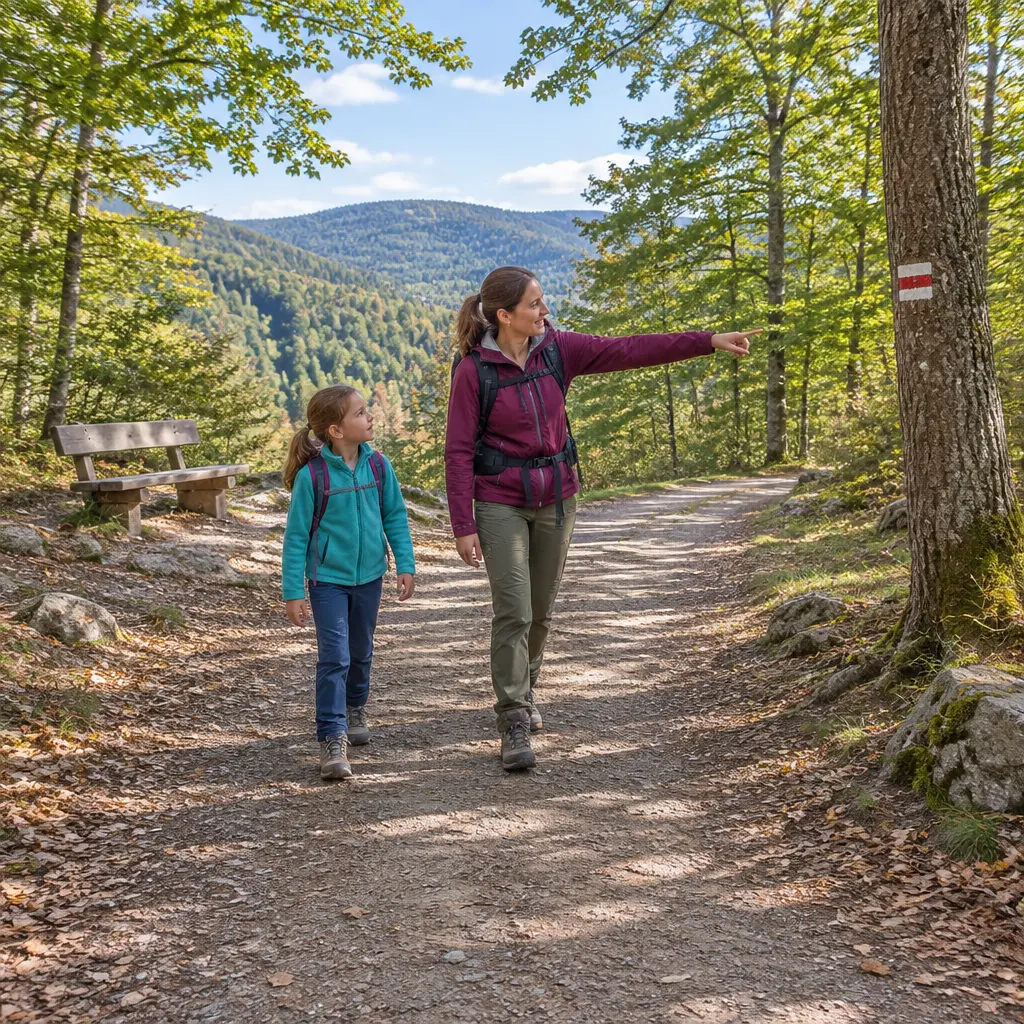
Regular pauses give children time to drink, eat, rest, and notice their surroundings. Divide the walk into small goals, such as reaching the next bridge or bench, rather than focusing only on the trail’s endpoint. If a child shows signs of exhaustion, overheating, pain, or distress, stop and reassess rather than pushing on to meet a plan.
Make curiosity part of the route
Children often engage more when the landscape invites discovery. Try a sound-and-silence pause, look for animal tracks, or compare the textures of rocks without removing them. Follow local rules about wildlife and plants, keep a respectful distance from animals, and pack out all rubbish.
Choose goals that reward the whole group
A family’s “best” hike may be a short loop with shade and toilets, a stroller-suitable path, or a moderate trail leading to a favorite picnic spot. For example, a family new to hiking might choose a nearby nature loop, check its surface and facilities, and plan to stop at a pond before deciding whether to continue. That approach combines route research with an easy turnaround and makes future outings easier to tailor.
Conclusion: choose the trail your family can enjoy together
A rewarding family hike begins with a route that fits the group’s ability, not an arbitrary mileage goal. Compare distance, time, elevation, terrain, and facilities; choose a trail type that offers flexibility or a motivating destination; and check weather, trail notices, supplies, and daylight. Then let children’s pace and curiosity shape the outing. Start with a manageable route, observe how everyone responds, and use that experience to choose the next one. For further planning, consult the current guidance from the National Park Service and your local park or trail manager.
Sources: National Park Service, “Plan Like a Park Ranger: Know Before You Go,” https://www.nps.gov/articles/plan-like-a-park-ranger.htm; National Park Service, “The Ten Essentials,” https://www.nps.gov/articles/10essentials.htm; Centers for Disease Control and Prevention, “Physical Activity Guidelines for School-Aged Children and Adolescents,” https://www.cdc.gov/physical-activity-basics/guidelines/children.html